
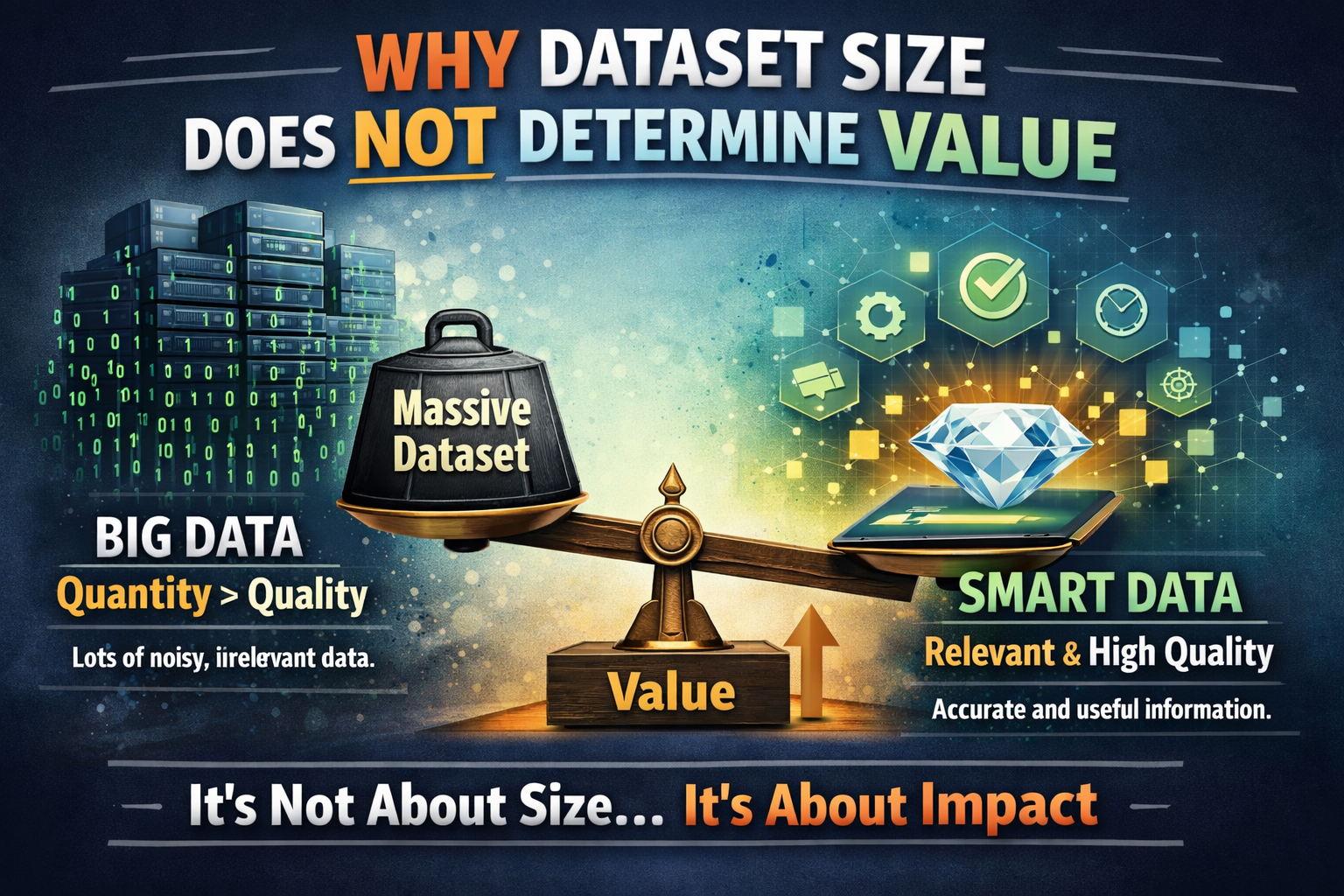
One of the most common assumptions about AI training data is that bigger datasets are more valuable.
But across observed dataset transactions, that assumption rarely holds.
While dataset size is often mentioned in technical documentation, it is not the primary driver of price in real-world data licensing agreements.
Instead, value is determined by a combination of factors including:
• Uniqueness of the underlying signal
• Difficulty of collection
• Contextual metadata richness
• Labeling quality
• Legal rights and licensing scope
• Substitutability of the data source
In some cases, extremely small datasets command significant prices.
For example, a narrow dataset capturing high-value behavioral events or specialized operational telemetry may contain signals that cannot easily be replicated.
Conversely, very large datasets of generic web or sensor data may have relatively low marginal value.
The result is a dataset economy where signal density often matters more than volume.
Understanding these dynamics is critical for organizations evaluating the acquisition or licensing of training data.
DatFlash tracks dataset transactions to help illuminate these market realities.