
AI governance is being treated like a policy problem. But it’s also an infrastructure problem.
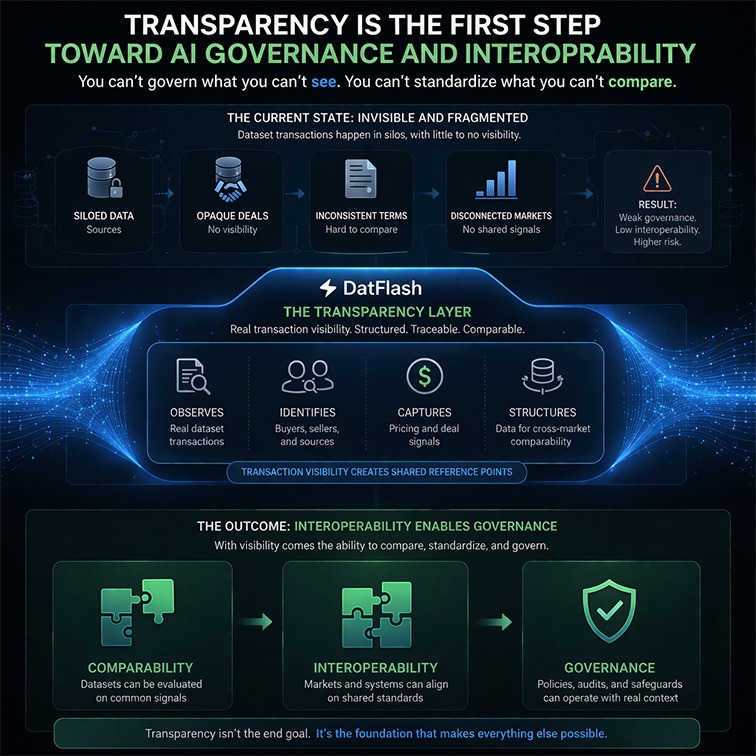
Right now, there’s no consistent way to observe how datasets actually move through the ecosystem.
Acquisition, licensing, aggregation, resale, most of it happens out of view.
That lack of visibility creates a bottleneck. Not just for governance, but for interoperability, because interoperability depends on comparability, and comparability depends on shared reference points.
Without them, every dataset is evaluated in isolation. Every decision is context-limited. Every system builds on incomplete signals.
You can’t standardize what you can’t see.
From our perspective, transparency isn’t a byproduct of governance, it’s a prerequisite.
Before frameworks, audits, or policy layers can be effective, there needs to be a baseline understanding of:
>How data is sourced
>How it changes hands
>How value is expressed across different types of datasets
That’s the gap DatFlash is focused on.
We’re building a visibility layer around real dataset transactions, structured in a way that allows patterns to emerge over time. Not as a marketplace. Not as a pricing authority. But as a reference system.
Because once transaction activity becomes observable, it becomes possible to compare. Once it’s comparable, it becomes possible to standardize.
That’s where interoperability begins, where governance can start to operate with real footing.
Is transparency being treated as infrastructure yet, or still as an afterthought?