
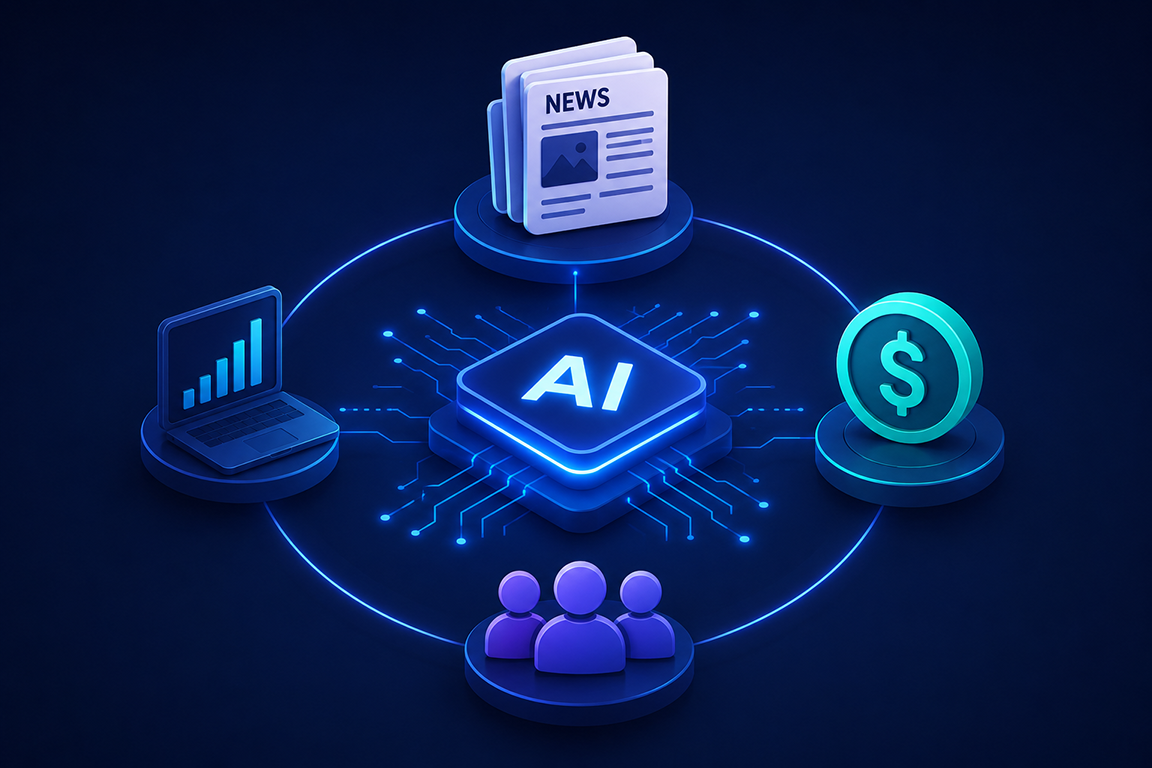
For the last two years, the AI licensing market has largely been defined by massive headline deals. OpenAI signing agreements with major publishers. Google compensating media companies for AI access. Meta building large-scale publisher pipelines into its Llama ecosystem.
Beneath those headlines, the market is beginning to evolve into something much more structured. What initially looked like isolated licensing agreements is now turning into an entirely new economic layer around live information access, AI training rights, and real-time content usage.
Three major structural shifts are now emerging.
1. The Shift Toward Pay-Per-Use AI Data Markets
The first generation of AI licensing deals resembled traditional enterprise media agreements: large upfront guarantees, fixed terms, and negotiated access rights.
That model is already starting to change. Instead of flat-rate licensing, major technology firms are building systems that meter how AI models actually consume information in real time.
Microsoft’s upcoming Content Marketplace is one of the clearest examples. Publishers including the Associated Press and USA Today Co. are participating in a framework designed to track how frequently AI systems like Copilot surface, summarize, or rely on publisher content. Compensation increasingly becomes tied to measurable usage rather than static licensing alone.
At the same time, new infrastructure companies are emerging specifically to support this transition. Parallel, the startup launched by former Twitter CEO Parag Agrawal, introduced a platform called Index that functions as a dynamic attribution and compensation layer for AI systems. Publications such as The Atlantic are participating in experiments where publishers receive revenue-sharing payments whenever AI systems retrieve or utilize their content.
Even more notably, OpenAI CEO Sam Altman has publicly discussed the long-term possibility of AI-driven micropayment systems. In that model, autonomous AI agents—not necessarily end users—could automatically compensate publishers with fractional payments whenever live information is retrieved to complete a task.
If that model expands, it would represent a major shift in how digital information markets function.
The internet historically monetized through advertising impressions and subscriptions. AI systems may introduce a third layer: machine-to-machine transactional data payments.
2. Big Tech Is Building Massive Publisher Syndication Networks
The second structural trend is scale.
Technology companies are no longer negotiating isolated content deals. They are building large multi-publisher licensing ecosystems designed to legitimize and stabilize AI training pipelines.
Meta has aggressively expanded partnerships with organizations including CNN, Reuters, Fox News, USA Today, and Le Monde Group. These agreements provide text and media pipelines that directly support Meta’s open-weight Llama models.
Google has pursued a similar strategy through its AI partnership initiatives with publishers such as The Guardian, The Washington Post, El País, and Der Spiegel. These relationships not only provide access to content, but also allow Google to test AI-generated summaries and search experiences tied directly to publisher material.
Meanwhile, Perplexity AI continues to build one of the most expansive real-time publisher integration networks in the market. Its agreements with USA Today Co. and hundreds of affiliated local publications are helping power citation systems, live search experiences, and AI-native browsing interfaces.
The broader trend is becoming increasingly clear: AI companies are no longer simply “scraping the web.” They are attempting to formalize structured, legally defensible, continuously refreshed information supply chains.
As regulators, courts, and publishers apply more pressure to AI firms, legally sourced and commercially licensed datasets may become a strategic competitive advantage rather than simply a compliance requirement.
3. Publishers Are Beginning to Organize Collectively
Not every publisher has the leverage of a global media conglomerate. And that reality is beginning to reshape negotiations across the industry.
Smaller publishers, independent creators, and regional media organizations increasingly recognize that negotiating individually against trillion-dollar technology firms creates a significant imbalance in bargaining power. As a result, collective licensing efforts are starting to emerge.
Industry associations and publishing coalitions are pushing for standardized frameworks that would establish uniform compensation structures for AI usage rather than fragmented private deals negotiated company by company.
The objective is straightforward: prevent a future where only the largest publishers can monetize AI access effectively while smaller content producers are excluded from the market.
Frameworks such as the EU AI Act are increasing demands for transparency around training data sources, attribution, and rights management. As governments require more visibility into how AI systems are trained and updated, publishers gain stronger legal footing to demand compensation and participation in the value chain.
The result is that AI data licensing is evolving from isolated corporate agreements into a broader economic and regulatory infrastructure layer.
The Bigger Shift
What is emerging is not just a collection of media deals.
It is the early formation of a machine-scale information economy.
AI systems require continuously refreshed, legally usable, commercially reliable data inputs. Publishers, creators, and information providers increasingly recognize that their content is not simply traffic-generation material—it is infrastructure for AI systems themselves.
That changes the economics entirely.
The next phase of the market will likely revolve around:
- real-time usage metering,
- attribution infrastructure,
- dynamic compensation systems,
- collective licensing frameworks,
- and increasingly formalized data supply chains.
In other words, the AI industry is beginning to move from unstructured data extraction toward structured information markets.
And that transition may become one of the defining economic shifts of the AI era.