
In most asset markets, trust influences value.
Investors want confidence in financial statements. Homebuyers want confidence in property records. Collectors want confidence in authenticity and ownership history.
Data is no different.
As datasets become increasingly important inputs for artificial intelligence, analytics, research, and decision-making, provenance is emerging as one of the most important factors influencing value.
Simply put, provenance helps answer a critical question:
Can the origin of this data be trusted?
The answer often has a direct impact on how a dataset is perceived, evaluated, and ultimately valued.
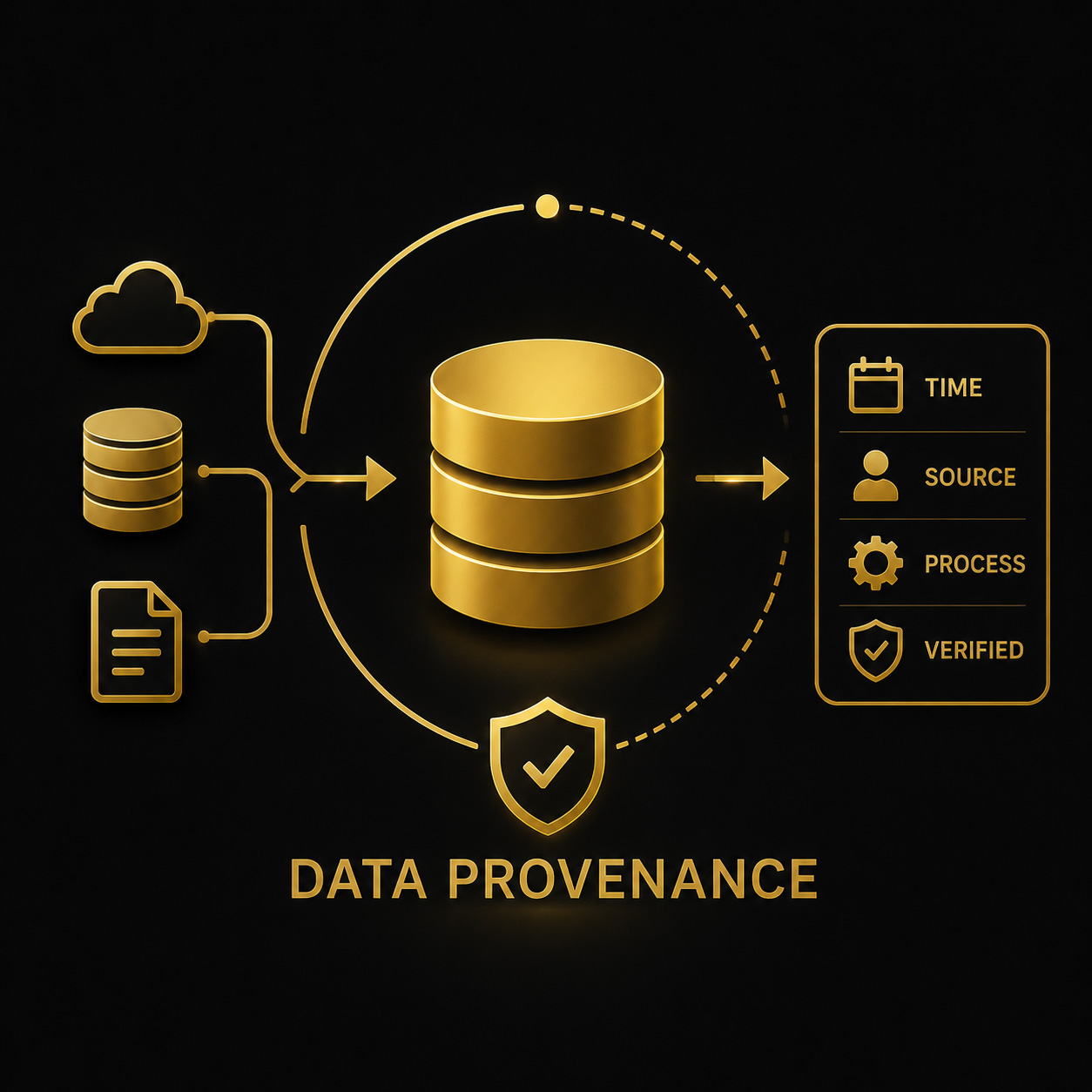
Provenance refers to the documented history of a dataset. It establishes where information came from, how it was collected, who collected it, and what evidence exists to support those claims. In many cases, provenance also includes verification records, collection methodologies, audit trails, and other forms of supporting documentation.
Without provenance, buyers are often forced to rely on assumptions.
A dataset may appear complete and well-structured, but uncertainty remains. Was the information collected consistently? Were measurements performed correctly? Has the dataset been altered over time? Can important records be verified? The inability to answer these questions introduces risk, and risk tends to reduce value.
This becomes particularly important in AI applications.
Organizations deploying AI systems increasingly face pressure to understand the origins of the information used to train, evaluate, and support those systems. As a result, datasets with strong provenance are often viewed differently than datasets with similar content but weaker documentation.
Consider two datasets covering the same subject matter. Both contain similar records, similar coverage, and similar apparent quality. One dataset includes detailed collection procedures, source attribution, verification records, and supporting evidence. The other provides little information about how the data was created. Even if the contents appear similar, most buyers would view the first dataset as carrying less uncertainty.
That difference in uncertainty can influence value.
At DataUniversa, provenance forms one of the foundational components of dataset evaluation. Before assessing interoperability, admissibility, or broader utility, it is important to establish whether the origins of the information can be demonstrated and defended. Provenance is often the first layer of trust upon which all subsequent analysis depends.
This relationship becomes even more important when datasets are connected together. Through the Global Model Intelligence Platform (GMIP), DataUniversa focuses on creating interoperable information ecosystems. However, interoperability becomes far more powerful when participating datasets have well-established provenance. Trustworthy inputs generally produce more trustworthy outputs.
Provenance also plays a role in dataset audits. As discussed in our Dataset Audit Framework, one of the first objectives of an audit is determining whether the origins of information can be verified. Datasets with stronger provenance frequently perform better during audit processes because they provide greater transparency into how information was generated and maintained.
From a market perspective, provenance does not determine value by itself. Demand, uniqueness, interoperability, coverage, and applicability all contribute to valuation. However, provenance often influences how confidently buyers can evaluate those characteristics.
This is one reason DatFlash views provenance as an important valuation signal. Transaction activity helps reveal what buyers are acquiring, licensing, and integrating. Provenance helps explain why some datasets command greater confidence than others.
As the data economy continues to mature, provenance is likely to become increasingly important. Organizations are becoming more sophisticated in how they evaluate data assets, and questions surrounding origin, verification, and trust are receiving greater scrutiny than ever before.
In the end, provenance does not create value on its own.
What it creates is confidence.
And in many markets, confidence is one of the foundations upon which value is built.