
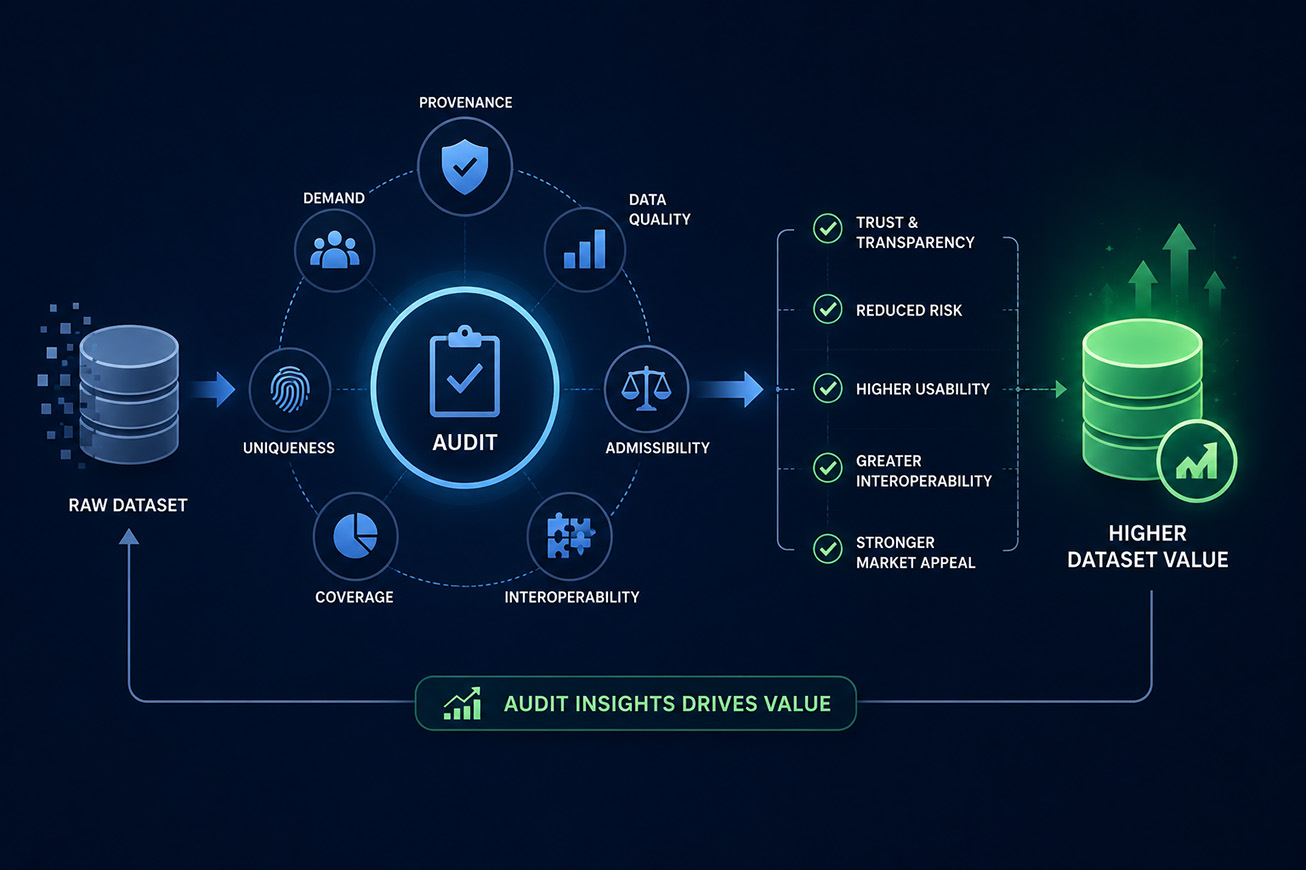
One of the recurring misconceptions in the data economy is that dataset value is primarily determined by size. Organizations often describe their assets in terms of records, files, images, transactions, or years of collection, as though volume alone explains worth. Yet anyone who has spent time evaluating real-world datasets quickly discovers that two datasets of similar size can have dramatically different market outcomes.
The reason is that buyers are not purchasing rows. They are purchasing confidence.
When a company acquires a dataset, licenses access to one, or incorporates external data into an AI system, it is also inheriting a series of questions. Where did this information come from? How was it collected? Can it be verified? Is it complete? Can it be integrated with existing systems? The more uncertainty surrounding those questions, the greater the risk associated with the asset.
This is where dataset audits become relevant.
A dataset audit is not a valuation exercise in itself. An audit will not tell an owner that a dataset is worth a specific dollar amount. What it does provide is a structured understanding of the characteristics that influence value. In many respects, an audit serves a role similar to due diligence in a corporate acquisition. It helps establish what is actually known about the asset and where the major risks reside.
Consider two organizations offering similar datasets. Both may cover the same subject matter and contain roughly the same number of records. One organization can clearly demonstrate how the data was collected, who collected it, how records were verified, and how the dataset has been maintained over time. The other cannot. Even before market demand is considered, those datasets are unlikely to be viewed the same way by potential buyers.
This distinction becomes even more important as artificial intelligence systems increasingly depend on external information. A dataset with weak provenance, limited documentation, or uncertain collection methods may still contain useful information, but it introduces additional risk. A dataset with strong documentation and traceable origins is generally easier to trust, easier to defend, and easier to deploy.
Interoperability is another area where audits often reveal important valuation signals. Modern data assets rarely exist in isolation. Their usefulness increasingly depends on their ability to connect with other datasets, participate in larger information ecosystems, and support applications beyond their original purpose. Audits frequently uncover structural strengths or weaknesses that affect how easily a dataset can be integrated into broader workflows.
At DatFlash, we view audits as one part of a larger valuation picture. DatFlash tracks transaction activity, acquisitions, licensing events, and other signals across the data economy. These market signals help explain what buyers appear to be pursuing. Audits help explain why certain assets may attract more interest than others.
Neither perspective is sufficient on its own. Market activity without asset analysis provides an incomplete picture of value. Asset analysis without market activity lacks commercial context. The combination of the two creates a more useful framework for understanding how data assets are perceived, evaluated, and ultimately transacted.
As the data economy continues to mature, organizations are likely to place increasing emphasis on the characteristics that audits reveal. The datasets attracting the strongest interest are often not simply the largest. They are the datasets that can be understood, trusted, verified, and integrated with confidence.
For that reason, a dataset audit should not be viewed as a compliance exercise. It is one of the primary tools available for understanding the qualities that contribute to value and the risks that may limit it.