
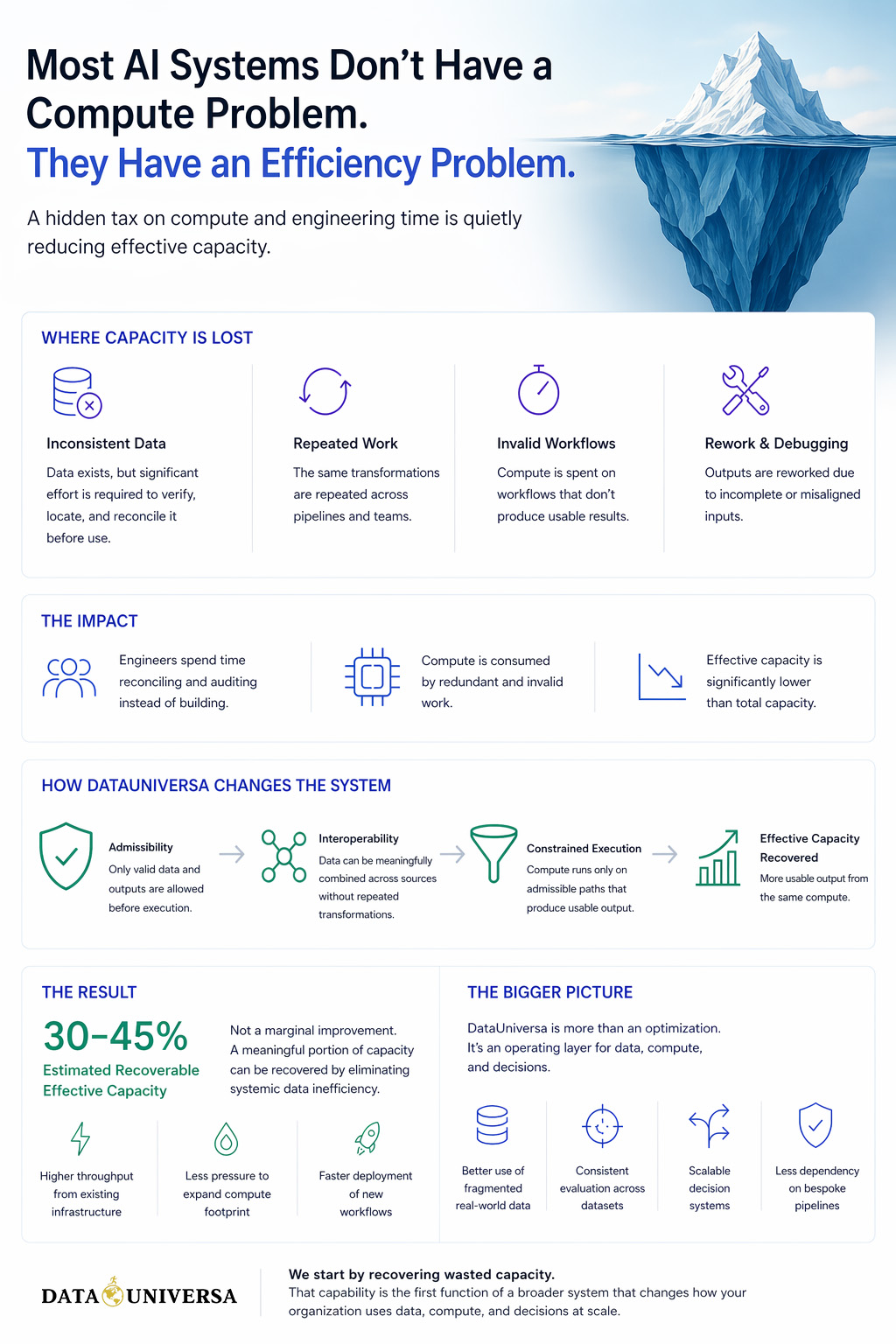
Most artificial intelligence systems today are not limited by how much compute they have, but by how much of that compute actually produces usable output.
A meaningful portion of both machine resources and engineering time is spent on work that never fully translates into value. Data must be reconciled across inconsistent sources, transformations are repeated across multiple pipelines, workflows are executed that ultimately produce unusable results, and outputs often need to be reworked due to incomplete or misaligned inputs.
Over time, this creates a hidden constraint. While systems may appear to have significant capacity on paper, the portion of that capacity that actually produces meaningful output is much lower. Effective capacity, not total capacity, becomes the real limiting factor.
What DataUniversa Actually Does
DataUniversa is not simply an optimization layer. It functions as a governing system for how data is structured, validated, and used within computation.
It defines how data from different sources can be combined, determines what compute is allowed to run, and establishes which outputs are considered admissible. At its core, it enforces two key principles: interoperability and admissibility.
Interoperability ensures that data can be meaningfully combined across sources, while admissibility ensures that both data and outputs meet defined criteria before they are used. These are not just technical constraints, they fundamentally change how systems behave.
Why This Changes System Behavior
When data is structured in a way that enforces interoperability, the system no longer needs to repeatedly transform the same inputs. Reconciliation effort drops, invalid execution paths are avoided, and workflows become reusable rather than one-off.
One of the first measurable outcomes of this shift is an increase in effective capacity. Systems begin to produce more usable output without requiring additional compute.
But the impact extends beyond efficiency. As structure improves, fragmented data becomes more usable, decision systems become more reliable, and new capabilities can be deployed faster. Evaluation across datasets also becomes more consistent, which is critical for any system operating at scale.
Where Capacity Is Lost Today
Across organizations, a consistent pattern emerges. Systems indicate that data exists, but significant effort is required to verify, locate, validate, and reconcile it before it can actually be used.
This leads to engineering teams spending time on data audits, running through multiple reconciliation loops, and duplicating work across teams and pipelines. This is not an edge case, it is baseline behavior in most environments.
In parallel, compute resources are consumed by work that should not have been executed in the first place, repeated transformations across pipelines, and workflows built on data that ultimately proves unusable.
The result is a system where both human and machine capacity are quietly degraded.
How Capacity Is Recovered
The recovery of effective capacity does not come from a single optimization. It comes from reducing waste at multiple stages of the system.
Before execution, work that will not produce usable output is prevented entirely. During transformation, repeated data processing is eliminated. At execution, compute is constrained to valid, admissible data paths.
This combination reduces unnecessary computation, removes redundant workflows, and allows systems to operate more directly on usable data.
What the Gains Look Like
In environments with moderate to high data fragmentation, recoverable effective capacity often falls in the range of 30 to 45 percent.
This is not a marginal improvement. Systems operating in this range are typically constrained by inefficient use of compute and engineering effort spent resolving data friction. Recovering that capacity translates into higher throughput from existing infrastructure, reduced need to expand compute resources, and faster deployment of new workflows.
The exact gains will vary. Cleaner, more aligned environments will see smaller improvements, while fragmented, real-world data environments tend to see significantly higher recovery. But the underlying pattern remains consistent: the more fragmented the system, the more capacity can be recovered.
The Broader System Shift
Effective capacity recovery is often the first visible benefit, but it is not the end state.
What emerges is a broader operating layer that governs how data, compute, and decisions interact. This enables consistent cross-dataset evaluation, more scalable decision systems, and better use of real-world, unstructured data. It also reduces reliance on bespoke, one-off pipelines that are difficult to maintain and scale.
Closing Thought
Most organizations assume they need more compute.
In reality, many systems already have the capacity they need, it is simply being lost to inefficiency.
Recovering that capacity is not just an optimization exercise. It is the first step toward a system where data, compute, and decision-making are aligned and scalable.
And once that alignment exists, everything built on top of it becomes more efficient, more reliable, and more capable.